

The question will ai easily replace search engines is no longer speculative rhetoric reserved for technologists and futurists. It has become a mainstream inquiry, driven by the rapid maturation of artificial intelligence systems capable of reasoning, summarizing, and conversing with a level of fluency once considered implausible. Search engines, historically designed to index and retrieve information, now face a paradigm shift. AI does not merely retrieve. It interprets, synthesizes, and extrapolates.
This evolution forces a deeper examination of how humans access knowledge in the digital era. Search engines have long acted as gateways to information, while AI models aspire to be interlocutors of knowledge itself. The distinction is subtle, yet consequential. Understanding whether replacement, coexistence, or convergence is the likely outcome requires unpacking technology, economics, behavior, and environmental cost in equal measure.
will AI Easily Replace Search Engines? No, AI won't fully replace search engines but is transforming them into AI-augmented tools, creating a hybrid future where AI handles quick answers and complex queries, while traditional search offers real-time updates and verified sources. Major players like Google are integrating AI (like Gemini, SGE) into existing search, not abandoning it, with AI complementing, not replacing, the core functions of finding diverse, source-backed information.
AI Easily Replace Search Engines, The Historical Role of Search Engines
Search engines emerged to solve a fundamental problem: how to navigate an exponentially growing web. Early systems relied on rudimentary keyword matching. Over time, algorithms evolved to evaluate authority, relevance, freshness, and user intent. Google refined this approach by integrating link analysis, machine learning, and behavioral signals, transforming search into an indispensable infrastructure of the modern internet.
AI easily replace search engines For decades, the model remained stable. Users posed queries. Search engines returned ranked lists of links. The cognitive labor of interpretation remained with the user. This paradigm shaped content creation, digital marketing, journalism, and commerce. Entire industries grew around optimizing visibility within these systems.
The emergence of AI challenges this equilibrium. When a system can answer questions directly, the necessity of navigating multiple sources diminishes. This shift underpins the persistent question: will ai replace google search, or simply redefine its interface and purpose?
AI Replace Search Engines, Understanding AI-Driven Search
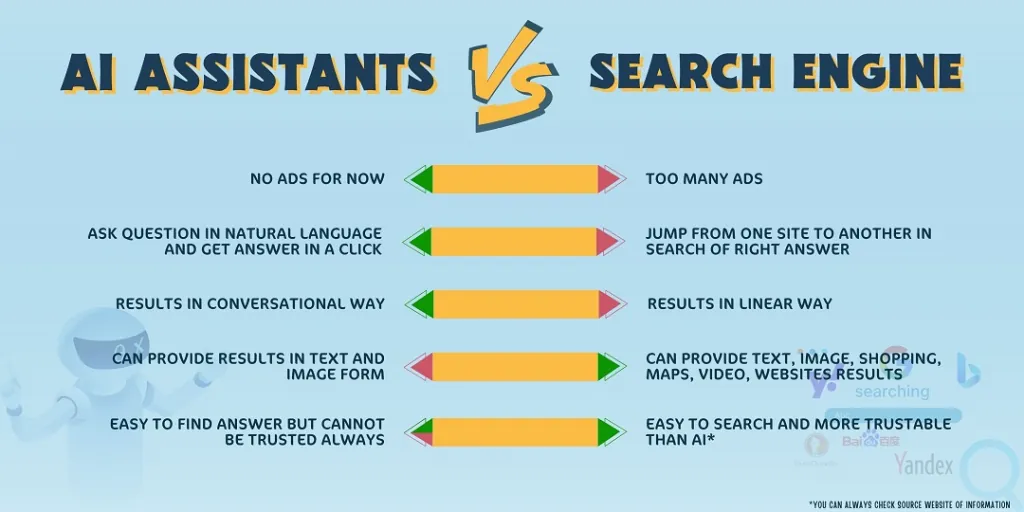
AI easily replace search engines To assess disruption, one must first address what is the difference between ai and search engine in functional terms. A traditional search engine is an indexer and ranker. It maps content and orders it based on relevance signals. AI-driven systems, particularly large language models, operate probabilistically. They generate responses based on learned patterns across vast datasets.
AI search emphasizes semantic understanding rather than lexical matching. Queries become conversational. Ambiguity is resolved contextually. Instead of offering ten blue links, AI produces synthesized responses. This alters the epistemic contract between user and system. Authority shifts from external sources to the AI’s internal model of knowledge.
Yet this capability introduces epistemological risks. AI systems can hallucinate, misattribute, or oversimplify. Search engines, by contrast, expose sources explicitly, preserving transparency. This tension informs debates about trust, accuracy, and accountability.
Will AI Replace Google Search or Transform It
The notion will ai replace google search assumes a zero-sum outcome. Reality appears more nuanced. Google has not resisted AI; it has absorbed it. From RankBrain to BERT and beyond, AI has long been integral to search ranking and interpretation. Recent developments merely externalize AI’s role from backend optimization to user-facing interaction.
Rather than replacement, integration dominates. AI-generated summaries coexist with links. Conversational search augments traditional results. This hybrid model preserves advertising revenue while responding to changing user expectations.
Replacement would require a wholesale shift in monetization, trust, and regulation. Given Google’s infrastructural entrenchment and economic incentives, displacement is improbable in the near term. Evolution, however, is inevitable.
Google vs AI Who Will Win
The binary framing google vs ai who will win simplifies a complex ecosystem. Google is not merely a search engine; it is an advertising platform, data aggregator, and infrastructure provider. AI companies, meanwhile, are building tools optimized for cognition rather than navigation.
Victory depends on criteria. If measured by market dominance, incumbents retain advantage. If measured by user satisfaction for complex queries, AI excels. If measured by scalability and profitability, search engines remain formidable.
The likely outcome is not a singular winner, but a stratified landscape. AI will dominate exploratory, analytical, and creative queries. Search engines will persist for transactional, navigational, and real-time information. The competition reshapes boundaries rather than erasing them.
AI Replacing Search Engines: Myth or Trajectory
Claims of AI easily replace search engines often overlook structural constraints. Search engines are deeply integrated into browsers, operating systems, and devices. They are optimized for speed, reliability, and breadth. AI systems, while powerful, are computationally expensive and occasionally unreliable.
Replacement would require AI to match search engines in latency, accuracy, and cost efficiency across billions of daily queries. At present, AI excels in depth but struggles with scale. This asymmetry suggests complementarity rather than substitution.
However, niche replacement is plausible. For research, coding, planning, and education, AI increasingly supplants traditional search behavior. These domains foreshadow broader shifts, even if full replacement remains distant.
Market Share and User Behavior Shifts
Data on google search vs ai search market share reveals a stark imbalance. Google commands the vast majority of global search traffic. AI tools, while rapidly growing, represent a fraction of this volume. Yet market share alone obscures behavioral nuance.
Users increasingly bifurcate their information-seeking habits. Simple queries default to search engines. Complex questions migrate to AI interfaces. This duality reflects cognitive efficiency rather than allegiance. Users choose tools based on task, AI easily replace search engines is not ideology.
Over time, as AI interfaces become faster and more transparent, this balance may shift. Market share lags behavior. The inflection point, if it occurs, will be gradual rather than abrupt.
Environmental Considerations of AI and Search
The debate ai vs google search environmental impact introduces a critical dimension often neglected in technological enthusiasm. Data centers consume vast energy. Search engines, optimized over decades, execute queries with remarkable efficiency. AI models, particularly large generative systems, require substantial computational resources for both training and inference.
Similarly, ai search vs google search energy usage highlights disparities in per-query cost. An AI-generated response can consume orders of magnitude more energy than a traditional search query. This raises sustainability concerns as usage scales.
However, efficiency improvements, specialized hardware, and renewable energy integration may mitigate this gap. Environmental impact thus becomes a moving target, contingent on innovation and policy rather than inherent limitation.
Economic Models and Incentives
Search engines monetize attention through advertising. AI systems struggle with this model. Direct answers reduce click-through rates, undermining ad impressions. This economic tension constrains AI’s role in open web search.
Subscription models, enterprise licensing, and API access offer alternatives. Yet these approaches limit accessibility. The democratizing promise of search engines contrasts with the gated nature of many AI tools.
Economic incentives shape technological trajectories. Until AI discovers a scalable, non-intrusive monetization model, replacement of ad-driven search remains constrained.
AI Easily Replace Search Engines Information Authority and Trust
Search engines externalize authority. They point outward. AI internalizes authority. It speaks with apparent confidence. This shift affects how users evaluate truth. Transparency becomes paramount.
Citations, source linking, and explainability are increasingly demanded of AI systems. Without them, trust erodes. Search engines benefit from decades of iterative trust-building. AI must earn similar credibility.
This dynamic influences adoption. Users may prefer AI for brainstorming but revert to search engines for verification. Trust, not capability, becomes the limiting factor.
Regulation and Governance
Regulatory frameworks lag innovation. Search engines are subject to antitrust scrutiny, content moderation laws, and privacy regulations. AI systems face emerging governance around data usage, bias, and accountability.
Replacement implies inheritance of regulatory burden. AI companies would assume responsibilities historically borne by search engines. This transition is nontrivial. Compliance costs, legal risk, and public scrutiny shape strategic decisions.
Regulation thus acts as a stabilizing force, slowing abrupt displacement and encouraging incremental integration.
How Will AI Easily Replace Search Engines
The more productive question is how will AI Easily Replace Search Engines rather than whether it will replace them. Change is already evident. Search results are becoming conversational. Queries are interpreted semantically. Personalization deepens.
AI enhances search by reducing friction between question and answer. It abstracts complexity. It anticipates intent. It reshapes interface design. Voice, multimodal input, and predictive suggestions redefine interaction.
Search engines evolve from directories to assistants. This transformation preserves core functionality while expanding capability. Replacement becomes irrelevant when identity itself changes.
Knowledge Discovery in an AI-Augmented World
Knowledge discovery shifts from exploration to synthesis. Search engines facilitate exploration by exposing diverse sources. AI facilitates synthesis by integrating information into coherent narratives.
Each approach has epistemic value. Exploration encourages critical thinking. Synthesis accelerates understanding. An optimal system balances both.
Future platforms may allow users to toggle between modes. Raw search results coexist with AI-generated summaries. Agency remains with the user.
Cultural and Cognitive Implications
The way humans seek information shapes cognition. Search engines encourage skimming, comparison, and cross-referencing. AI encourages dialogue and reliance.
Excessive dependence on AI risks cognitive atrophy. Conversely, judicious use enhances productivity. Cultural norms will determine balance.
Education systems, media literacy initiatives, and interface design play roles in shaping healthy usage patterns. Replacement narratives overlook these sociocognitive dimensions.
Global Perspectives and Access
Search engines democratized access to information globally. AI risks reintroducing asymmetry if access is gated by cost or infrastructure. Language support, cultural context, and localization matter.
AI’s potential to bridge linguistic divides is significant. Multilingual models can expand access. Yet computational requirements may exclude regions with limited infrastructure.
Equitable deployment influences adoption. Replacement without inclusion exacerbates digital divides.
The Future Landscape of Information Retrieval
The future is pluralistic. Search engines persist. AI flourishes. Boundaries blur. Tools specialize.
Transactional queries remain with search engines. Analytical reasoning migrates to AI. Hybrid systems dominate mainstream usage. Users adapt fluidly.
The question will ai replace search engines ultimately reflects anxiety about change rather than inevitability of displacement. History suggests adaptation over extinction.