
The question surrounding editing software in the AI era is no longer speculative — it sits at the center of production workflows, academic curricula, and hiring decisions. Practitioners who treat this as a binary “replace or survive” debate are operating from a flawed premise. The relationship is structural, not competitive.
AI tools function as execution accelerators; editing software remains the architecture where those outputs are controlled, sequenced, and finalized. Understanding how these two systems interact requires a closer look at what each actually does at the process level, not the marketing level.
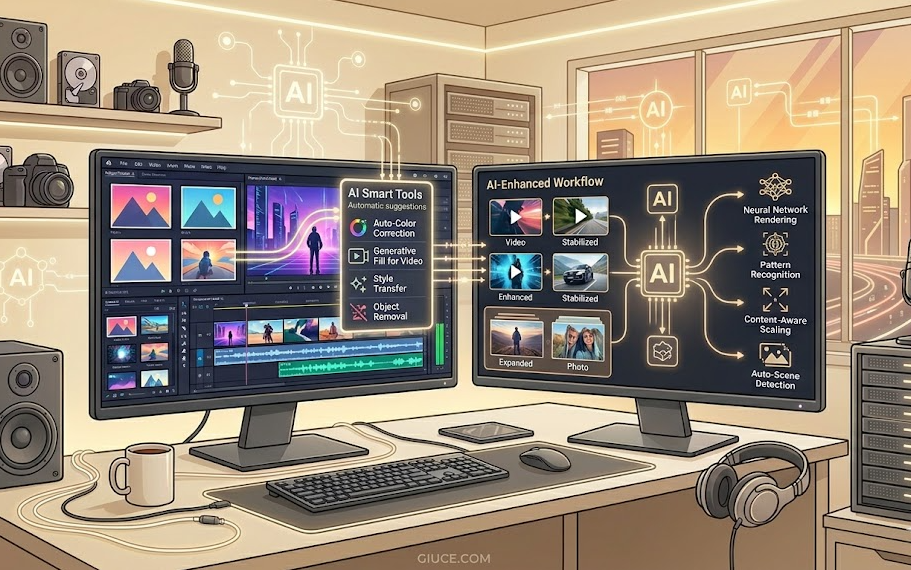
The Evolutionary Shift of Editing Software in the AI Era Tools
Editing software has never been static. From linear tape-based systems to non-linear digital platforms, each transition demanded retraining and restructured workflows. The current shift is different in velocity but not in kind. AI-integrated features are being embedded directly inside Adobe Premiere Pro,DaVinci Resolve, and Avid Media Composer — not as standalone replacements, but as layered capabilities within the existing environment.
The distinction matters because evolution in this context means the software is expanding its surface area, not ceding territory. Speech-to-text, auto-reframe, scene detection, and color matching through AI are now native features. Editors who fail to interpret this as an augmentation of their existing tools are misreading the product roadmap of every major developer in this space.
What has changed fundamentally is the entry cost for certain tasks. Rough cuts that once took hours can now be approximated in minutes. But approximation is not completion. The gap between a machine-generated rough assembly and a broadcast-ready sequence is still measured in human editorial decisions — pacing, emotional arc, tonal coherence. Evolution in this domain means the software environment absorbed AI, not the reverse.
AI Will Not Make Editors Obsolete
The claim that AI will fully replace human editors collapses under technical scrutiny. Current generative and analytical AI systems lack persistent contextual judgment across a full project timeline. They optimize for local pattern completion, not global narrative coherence. An AI tool can identify a clean cut point; it cannot determine whether that cut serves the emotional intent established in scene one.
Professional editing demands decision-making under ambiguity — a client who says “make it feel warmer” is not issuing a computable instruction. Translating subjective direction into technical execution requires interpretive capacity that remains outside the current capability envelope of any deployed AI system. This is not a temporary gap; it reflects a structural difference between pattern recognition and meaning construction.
The Motion Picture Editors Guild and similar professional bodies have documented consistent demand for credentialed editors even as AI tool adoption increases. The economic signal is clear: automation of subtasks does not flatten the market for the humans who manage the full workflow. It restructures which subtasks are worth billing for, but the editorial role itself remains intact.
How Editing Software and AI Adoption Work Together
The practical integration model is collaborative, not substitutive. AI handles volume tasks — transcription, noise reduction, frame interpolation, object removal — while the editor operates within the software to apply judgment at decision points that require it. This division is already visible in live production environments.
Adobe’s Firefly integration within After Effects and Premiere allows generative fill and text-to-video prompting inside the same timeline where a colorist or motion designer is already working. The AI does not open a separate application; it executes within the editor’s existing spatial environment. The editor remains the agent making compositional decisions. AI is the process layer that executes certain instructions faster.
This collaboration model also changes how editors structure their time. Less time spent on mechanical repetition means more time available for high-judgment work: story structure, pacing analysis, client communication, creative problem-solving. Workflows built around this division show measurable efficiency gains without reducing the editor’s functional authority over the final product.
The software itself becomes the integration point. Understanding how to configure, direct, and correct AI-generated outputs inside a platform like Final Cut Pro or DaVinci Resolve is a skill set distinct from knowing how to use the AI model in isolation. The software remains the frame.

Practical Workflow Implementation in Real Production
Implementation at the production level requires deliberate architecture. Studios and agencies that have successfully integrated AI into editorial workflows share a consistent structural pattern: AI tools are assigned to defined pipeline stages with explicit human checkpoints.
In a standard documentary workflow, for example, AI transcription and rough-cut assembly might handle the first pass. An editor then reviews the assembly against the transcript, restructures sequences, and makes pacing decisions before passing to color grading. Color AI tools within DaVinci Resolve — such as Magic Mask and Color Warper — are then applied under colorist supervision, not autonomously.
This stage-gated model prevents the compounding error problem, where AI outputs accepted without review introduce inconsistencies that become expensive to correct downstream. Practical implementation means defining where AI operates, under whose oversight, and with what correction protocols.
The editing software environment is what makes this oversight structurally possible — it provides the interface through which human judgment intervenes at designated points.
Productions using unstructured AI integration, where AI tools are applied ad hoc without workflow definition, report higher revision rates and longer delivery cycles. The efficiency gain from AI is conditional on the discipline of the workflow architecture surrounding it.
The Effect on Audio Editors and Sound Designers
Audio editing has been more directly affected by AI capability expansion than most visual disciplines. Tools such asi Zotope RX have made noise reduction, dialogue isolation, and spectral repair accessible at a quality level that previously required highly specialized skill sets. This has compressed the market for entry-level audio cleanup work.
However, sound design, music editing, and mix supervision have not experienced equivalent compression. These domains require aesthetic judgment, genre literacy, and an understanding of how audio interacts with picture at an emotional level — competencies that current AI tools do not replicate. A dialogue editor whose primary output was clean-up work faces a different market condition than a re-recording mixer managing a final theatrical dub.
The software itself has become more powerful. Pro Tools and Logic Pro have integrated AI-assisted features for pitch correction, timing quantization, and stem separation. These augment the mixer’s capability rather than replace their role. The net effect is that audio professionals working inside established software environments are more capable per session hour than they were five years ago — which changes pricing structures but not the fundamental demand for the human in the chain.
How Visual Editors Are Navigating AI Integration
For visual editors — motion graphics, VFX, cinematics — AI has introduced generative capability at the asset creation stage. RunwayML and similar platforms allow rapid prototyping of visual elements that previously required extensive manual labor. This accelerates concepting phases but does not eliminate compositing, technical QC, or the integration work required to make AI-generated assets match the visual language of a production.
Compositing inside Nuke or After Effects remains a high-skill discipline. AI-generated imagery typically requires significant cleanup, rotoscoping correction, and color matching to function within a professional pipeline. The visual editor’s role has shifted toward quality control and integration rather than ground-up asset construction for certain deliverable types.
This shift demands a different skill profile, not the elimination of the role. Visual editors who understand both the generative AI tools producing assets and the compositing software integrating them are positioned at a higher value point in the production chain. The tool set is wider; the judgment requirements remain.
What Happened to Editing Software Instructors
The instructional market for editing software has undergone significant restructuring. Platform-native tutorials, YouTube channels, and LinkedIn Learning courses have replaced much of what was previously taught in formal classroom settings by dedicated software instructors. The volume of free, high-quality instructional content available for Premiere Pro, DaVinci Resolve, and Avid has commoditized basic software instruction.
AI-powered tutoring tools, including those embedded in platforms like Coursera and various proprietary learning management systems, have further reduced the demand for human instructors covering foundational tool navigation. A learner can now receive adaptive, contextual instruction on keyframe animation or audio sync inside a virtual environment without requiring a live instructor.
What has not been replaced is instruction in editorial judgment. Mentorship in how to cut a scene for emotional impact, how to build a sound design approach for a specific genre, or how to manage a client revision process — this remains a human-to-human transfer. The instructors who have retained market position are those who shifted from teaching button locations to teaching decision frameworks. Software mechanics are now largely learnable without human instruction; editorial craft is not.
Human Precision Remains the Ceiling in Editorial Judgment
The granularity of human editorial judgment exceeds what any current AI system can replicate at the decision layer. Frame-accurate cutting, motivated by an understanding of performance subtext, cannot be systematized. A trained editor watching a performance reads micro-expressions, breathing patterns, and line delivery cadence to determine cut points. This is not a function of processing speed; it is a function of embodied perceptual experience.
In color grading, a colorist working inside DaVinci Resolve makes decisions that reference the cinematographer’s intent, the director’s mood brief, the genre’s established visual language, and the technical constraints of the delivery format simultaneously. AI-assisted grading tools provide starting points and technical automation, they do not hold the contextual knowledge required to weight those variables correctly.
The precision argument also applies to error detection. Human editors consistently identify continuity errors, audio sync drift, and tonal inconsistencies that automated QC systems miss. Netflix’s technical delivery requirements and similar broadcast specifications require human-verified QC passes even when AI QC tools are part of the pipeline. The human pass remains the final gate.

The Restructured Value Hierarchy in Post-Production
AI integration has not eliminated value in post-production, it has restructured where value concentrates. Tasks that were billable because they were time-consuming are now automated. Tasks that required skilled judgment remain billable, and at higher rates relative to the overall workflow.
This creates a bifurcation in the labor market. Editors who built their practice on volume tasks — basic color correction, simple assembly cuts, standard noise reduction — face margin compression. Editors who specialize in high-judgment work — narrative structure, complex sound design, VFX supervision — are seeing their relative value increase as the automated tier expands.
Platforms like Upwork show this bifurcation clearly: entry-level editing rates have dropped in categories where AI tools have made the work accessible to less experienced practitioners, while specialist roles command rates that reflect the scarcity of the judgment required. The software skills that matter most are now the ones that involve directing and correcting AI outputs, not just executing manual tasks.
Software Literacy as a Competitive Differentiator
In the current production environment, software literacy means more than knowing where the tools are. It means understanding which AI feature is appropriate for a given task, what its output quality ceiling is, and how to correct its failures inside the editing environment. This is a higher-order competency than the button-location knowledge that characterized entry-level software training.
Editors who can evaluate an AI-generated rough cut and identify specifically why it fails — whether the issue is pacing, tonal mismatch, or continuity logic — are operating at a diagnostic level that requires both editorial training and software fluency. This combination is not common and commands premium positioning.
The competitive differentiation is not between human editors and AI, it is between editors who understand how to work with AI inside professional software environments and those who do not. Blackmagic Design’s training resources for DaVinci Resolve now include AI tool operation as a core certification component — a signal that software literacy in the AI era is a defined, testable competency.
Industry Signals on the Software and AI Relationship
The investment behavior of major software developers is the clearest available signal about where this relationship is heading. Adobe’s acquisition strategy, Blackmagic’s consistent R&D investment in AI features within Resolve, and Avid’s integration roadmap all point in the same direction: AI is being built into editing software, not positioned against it.
None of the dominant players in professional editing software are building standalone AI editing systems intended to replace their flagship products. They are expanding those products. This investment pattern reflects the developers’ own assessment of where value resides: in the integrated environment where human judgment operates on AI-augmented workflows.
The market structure follows the same logic. Post-production houses are not dismantling their software infrastructure, they are expanding their AI tool subscriptions and integrating them into existing software environments. The editing software layer is not being bypassed — it remains the operational environment within which all tools, AI or otherwise, are deployed.
About the Author


