

The Year Holography Became Practical
By 2026, holography is no longer an exotic curiosity reserved for science expos or speculative fiction. It has matured into a pragmatic, multi-sector technology stack influencing communication, advertising, medicine, defense, education, and spatial computing. What was once constrained by low-resolution projections, narrow viewing angles, and excessive hardware complexity has evolved into adaptive, networked, and increasingly volumetric systems.
The story of holographic technology in 2026 is not about a single breakthrough. It is about convergence. Advances in photonics, AI-driven rendering, edge computing, micro-LEDs, waveguides, and spatial sensors have collapsed into an ecosystem where holograms function as interfaces, not illusions. They persist in space. They respond to users. They communicate data with dimensional context.
Short sentence.
This changes everything.
Holographic Technology in 2026 following analysis explores the technical foundations, commercial deployments, ethical considerations, and future trajectory of holography as it stands in 2026, while contextualizing why this year marks a decisive inflection point for immersive digital reality. inairspace.com
Holographic Technology in 2026, The Evolutionary Arc of Holography
Holographic Technology in 2026 From Optical Curiosity to Computational Medium
Traditional holography relied on interference patterns captured on physical media using coherent laser light. These static holograms, while visually impressive, were fundamentally inert. No interaction. No real-time modulation.
Holographic Technology in 2026 is Modern systems are different.
By 2026, holography is primarily computational. Light-field rendering engines simulate depth, parallax, occlusion, and luminance in real time. Instead of recording interference patterns, systems now generate them dynamically, guided by AI models trained on human depth perception and spatial cognition.
This transition has enabled:
- Real-time volumetric rendering
- Multi-user shared holographic spaces
- Adaptive resolution based on gaze tracking
- Context-aware holographic overlays
The hologram is no longer a projection.
It is a spatial object.
Holographic Technology in 2026, Hardware Foundations Powering 2026 Systems
Photonic Displays and Light-Field Emitters
At the core of modern holography are light-field displays capable of emitting directionally controlled photons. Unlike flat screens, these displays generate multiple viewing perspectives simultaneously, allowing different users to see distinct angles of the same hologram without head-mounted equipment.
Key developments include:
- Micro-LED arrays with nanosecond response times
- Phase-modulating spatial light modulators (SLMs)
- Diffractive waveguide stacks
- Laser-phosphor hybrid emitters
These components enable higher brightness, reduced speckle noise, and improved color fidelity, making holograms viable in ambient lighting conditions.
Spatial Sensing and Environmental Mapping
Holograms must coexist with the physical world.
They must understand it.
Systems in 2026 integrate dense sensor arrays combining LiDAR, structured light, ultrasonic ranging, and computer vision. This allows holographic objects to anchor accurately to real surfaces, avoid occlusion errors, and respond to environmental changes in milliseconds.
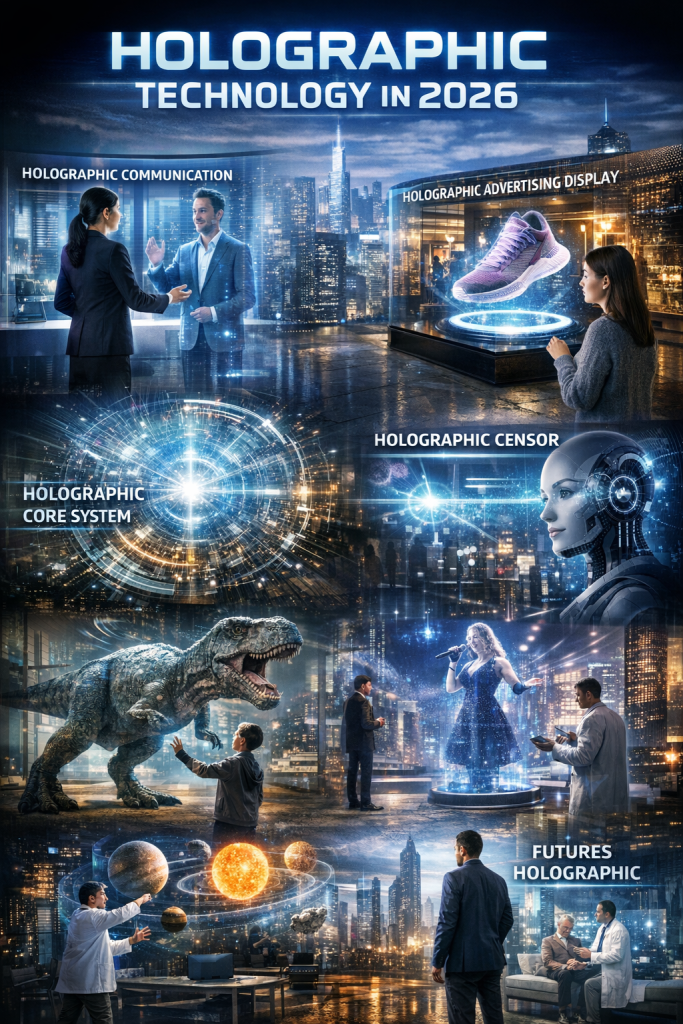
This sensing layer is often referred to as the Holographic Censor, a subsystem responsible for spatial awareness, motion prediction, and environmental semantics.
Software Architecture: The Invisible Engine
The Rise of the Holographic Core System
At the software level, holography now relies on modular orchestration layers known collectively as the Holographic Core System. This architecture manages rendering pipelines, sensor fusion, network synchronization, and user interaction.
A typical core system includes:
- Spatial operating systems
- Real-time ray reconstruction engines
- AI-based depth inference
- Edge-cloud hybrid computation
This abstraction allows developers to design holographic applications without direct control over photonic hardware, accelerating adoption across industries.
Holographic Technology in 2026, AI as a Perceptual Optimizer
Artificial intelligence plays a subtle but essential role. Rather than increasing raw resolution endlessly, AI models predict how humans perceive depth, contrast, and motion, allocating computational resources where perception is most sensitive.
This Holographic Technology in 2026 perceptual optimization reduces bandwidth consumption while improving realism.
Efficiency through cognition.
Holographic Communication: Beyond Video Conferencing
From Flat Presence to Spatial Co-Presence
Traditional video calls flatten human interaction. Holography restores dimensionality.
holographic Communication in 2026 enables life-sized, three-dimensional representations of participants, complete with eye contact, body language, and spatial audio. These systems reconstruct volumetric avatars in real time using multi-camera capture and neural reconstruction.
Applications include:
- Executive meetings across continents
- Remote medical consultations
- Distributed engineering collaboration
- Diplomatic and governmental communication
The psychological impact is profound. Studies show increased empathy, trust, and comprehension when interactions occur in shared holographic spaces rather than on flat screens.
Network Demands and Latency Solutions
Holographic communication is data-intensive. To function seamlessly, systems rely on:
- 5G Advanced and early 6G infrastructure
- Edge computing nodes for local reconstruction
- Predictive motion algorithms to mask latency
By 2026, latency below 10 milliseconds is achievable in urban environments, enabling natural conversation without perceptible delay.
Commercial Adoption Across Industries
Healthcare and Medical Visualization
In medicine, holography provides surgeons with volumetric reconstructions of patient anatomy derived from CT and MRI data. These holograms can be manipulated mid-procedure, offering perspectives impossible with traditional imaging.
Key benefits include:
- Improved surgical planning
- Reduced operative risk
- Enhanced medical education
Remote specialists can appear holographically in operating rooms, advising in real time without physical presence.
Manufacturing and Industrial Design
Engineers now prototype in space.
Literally.
Holographic models allow teams to walk around full-scale machinery, inspect internal components, and simulate mechanical stress visually. This reduces prototyping cycles and uncovers design flaws earlier in development.
The Advertising Revolution: Holograms as Urban Architecture
The Rise of Holographic Digital Media
Cities in 2026 are increasingly layered with holographic digital content. Transparent displays, volumetric projections, and spatial signage transform public spaces into dynamic information environments.
Unlike traditional billboards, holographic media adapts to:
- Viewer proximity
- Time of day
- Environmental conditions
- Demographic analytics
This adaptability increases engagement while reducing visual pollution through contextual relevance.
Holographic Advertising Display Systems
The holographic advertising display has become a centerpiece of premium retail, automotive launches, and global brand campaigns. These displays project products at true scale, allowing consumers to explore features interactively without physical inventory.
Retailers report:
- Higher dwell times
- Increased conversion rates
- Reduced physical footprint
Advertising has become experiential rather than declarative.
Consumer Technology and Entertainment
Home Holography and Personal Devices
While room-scale holography remains premium, compact tabletop systems have entered the consumer market. These devices project interactive holograms for gaming, education, and personal communication.
Entertainment applications include:
- Volumetric gaming environments
- Holographic concerts and performances
- Immersive storytelling experiences
The boundary between screen and space continues to erode.
Events That Defined the Market
CES Best 2025 and the Holographic Turning Point
Industry momentum accelerated dramatically following CES best 2025 showcases, where multiple vendors demonstrated commercially viable holographic platforms rather than prototypes. Analysts widely cite this event as the moment holography crossed from experimental to investable.
Among the CES 2025 top 10 technology highlights, holographic systems featured prominently, signaling mainstream recognition and accelerating enterprise adoption.
These demonstrations emphasized:
- Reliability over novelty
- Integration with existing workflows
- Scalability across environments
By 2026, the ripple effects are evident across global markets.

Evaluating the Best Holographic Technology in 2026
Criteria for Excellence
Determining the best holographic technology in 2026 requires evaluating systems across multiple dimensions:
- Visual fidelity and depth accuracy
- Environmental adaptability
- Latency and responsiveness
- Energy efficiency
- Software ecosystem maturity
Leading platforms distinguish themselves not through spectacle, but through stability, developer support, and real-world usability.
Enterprise vs Consumer Solutions
Enterprise-grade systems prioritize precision and integration, while consumer solutions emphasize accessibility and cost reduction. Both segments continue to influence each other through shared technological advances.
Ethical, Social, and Regulatory Considerations
Privacy in Spatial Media
Holographic systems continuously map environments and capture biometric data. This raises legitimate concerns regarding surveillance, consent, and data ownership.
Regulatory frameworks in 2026 increasingly address:
- Spatial data anonymization
- Consent mechanisms for shared environments
- Secure edge processing
Ethical deployment has become a competitive differentiator rather than an afterthought.
Psychological and Social Impact
Extended exposure to immersive holographic environments alters perception and attention patterns. Researchers study cognitive load, spatial memory adaptation, and social behavior shifts resulting from prolonged use.
Responsible design emphasizes:
- Transparency of virtual elements
- Clear boundaries between physical and digital
- User agency over immersion levels
Futures Holographic: Beyond 2026
Toward Persistent Spatial Computing
The concept of Futures Holographic extends beyond individual devices toward persistent, shared spatial layers that exist independently of users. In this vision, holographic content remains anchored in locations, accessible by anyone with compatible systems.
This suggests a future where:
- Cities have digital twins visible through holography
- Information exists contextually in physical space
- Interfaces dissolve into environments
Holography becomes infrastructure.
Challenges That Remain
Despite remarkable progress, limitations persist:
- High energy consumption for large-scale displays
- Cost barriers for mass adoption
- Standardization across platforms
These challenges are actively addressed through material science innovation, open standards, and economies of scale.
About the Author


